

If you typed “property financial advisor near me” into Google this week, you’re not idly browsing — you’re searching for something specific, and you already sense what most Sydney investors are slowly waking up to. The median Sydney dwelling now sits at $1.29M. The RBA cash rate is back at 4.35% after three hikes in 2026. And the financial planner you’ve been paying for years hands you a Statement of Advice that mentions every asset class on earth — except the one you actually want to buy.
Here is the truth most websites won’t tell you:
A generic financial planner in Australia is rarely licensed, trained, or incentivized to give you direct property advice. A property financial advisor is a different professional with a different remit, and in this market, that distinction is the difference between a portfolio that compounds and one that quietly bleeds.
This is the pillar piece I wish someone had written for me in 2010, covering what a property investment advisor actually does, how they differ from the other three professionals you will meet, why 2026 Sydney specifically needs this lens, suburb-level case studies, advice by investor profile, and how to choose one near you.
One who sits at the intersection of capital strategy, property selection, and structural finance. They look at your income, tax position, assets, borrowing capacity, time horizon and risk and build a property-led wealth plan around them. Not a managed-fund plan. A plan where direct residential and (where appropriate) commercial property is the core engine, with everything else supporting it.
That is a departure from what most Australians think they are hiring. A good property advisor spends the first meeting interrogating your cash flow, not your retirement projections. They ask whether your serviceability supports a second purchase in eighteen months. They model what an extra 25 basis points does at scale. They tell you when not to buy. They also do the unglamorous middle-game work portfolio reviews every six to twelve months, refinancing strategy, equity-release sequencing, ownership-structure adjustments, and exit planning.
A deeper view of the role sits in our Best Property Investment Consultant guide, and the methodology of turning goals into purchases is inside the Structured Wealth Plan framework. The biggest myth I have to bust every single week is that property financial advisors are just glorified salespeople in disguise. Leading this industry I have realized, the real ones actually have your back. They get paid for advice and only recommend stock when stock fits the plan. If the conversation starts with a property and only later constructs a plan to justify it, you are in the wrong room.
The most confused four-way distinction in Australian personal finance and worth getting right, because each professional has a different license, incentive, and blind spot.
A financial planner (or financial adviser — in Australia the titles are interchangeable) is licensed under an AFSL and regulated by ASIC. They give Statements of Advice on financial products super, managed funds, ETFs, insurance, shares. Crucially, the AFSL framework generally does not authorize specific advice on direct residential property. Most planners can tell you to allocate 40% to property but not which property, in which suburb, on which structure.
A buyer is agent and is licensed under real-estate legislation. They source, negotiate and secure property. Their remit starts when you have decided to buy and ends at settlement. They don’t model your tax, structure your loan, or sequence a multi-property portfolio.
A mortgage broker is licensed under credit law and matches you to a lender. The best are exceptional at loan structure interest-only periods, offset positioning, cross-collateralization traps. But brokers are paid by the lender, and their role ends at settlement. They don’t tell you whether the asset is right.
A property financial advisor sits above the transaction and connects all three. They build the strategy that determines what the buyer’s agent hunts for, what the broker structures, and what the planner leaves alone. They’re the quarterback.
To model the maths before any meeting, the Property Investment Calculator stress-tests a deal against your real numbers. For common questions fees, scope, conflicts — the FAQ page answers them in plain English.
Most Sydney investors I meet have hired three out of the four and wonder why their portfolio isn’t compounding. The reason is almost always that nobody owned the strategy layer.
The 2026 Sydney market isn’t the 2021 market, and the playbook that worked then is actively losing money now.
The RBA pushed the cash rate to 4.35% in May 2026 the third hike of the year with inflation still at 4.6% against a 2–3% target. Sydney dwelling values rose 6.4% in the twelve months to early 2026, but April recorded a 0.6% monthly decline and values now sit roughly 1% below the November 2025 peak. New listings are down 10.4% year-on-year, but stock is unwinding more slowly. The four major banks’ 2026 forecasts span a 3.7-point range ANZ at −0.7%, Westpac at +3%, Domain bullish at +7% for houses. That spread tells you the market is at an inflection point, not a trend point.
Inside that headline, segmentation is the real story. Above $2M is softening as borrowing capacity bites. The sub-$1.5M bracket eligibility for the expanded First Home Guarantee Scheme remains genuinely competitive. Australia is tracking toward a 400,000+ home shortfall by 2029, and Sydney is the most supply-constrained capital. That tension between short-term rate pressure and long-term scarcity is exactly the market where headline buyers lose and thesis buyers win.
This is the affordability inversion most Sydney buyers are wrestling with borrowing capacity has shrunk just as the structural case for owning Sydney property has strengthened. The dynamics are mapped in Sydney Affordability Trap 2026.
2026 has also created a closing window. The sub-$1M Sydney capital-growth play well-located inner-ring stock under the seven-figure mark was the portfolio kickoff for an entire generation. That window is shutting. Where the remaining opportunities sit: Sub-$1M Gains Final Window.
Most importantly, 2026 is the year the federal budget changed the math’s. The proposed reduction of the CGT discount on residential investment property from 50% to 33% materially shifts the return profile of negatively geared portfolios. It changes the optimal holding period, exit strategy, and ownership structure for new acquisitions. A planner can tell you the tax rules. A property financial advisor will tell you what to do about them. Full positioning playbook in our Sydney Property Investment Strategy 2026 guide
In one sentence I can say that the 2026 Sydney market rewards strategy more than it rewards courage.
The process looks nothing like a financial planner’s pie-chart review.
Session one is cash flow and time horizon. Not what do you want to buy? what does the next ten to fifteen years need to fund? Property is a long-duration asset with high transaction costs; getting the horizon wrong is the single most expensive mistake an investor can make. The full decision tree sits in Long-Term Property Planning vs Short-Term
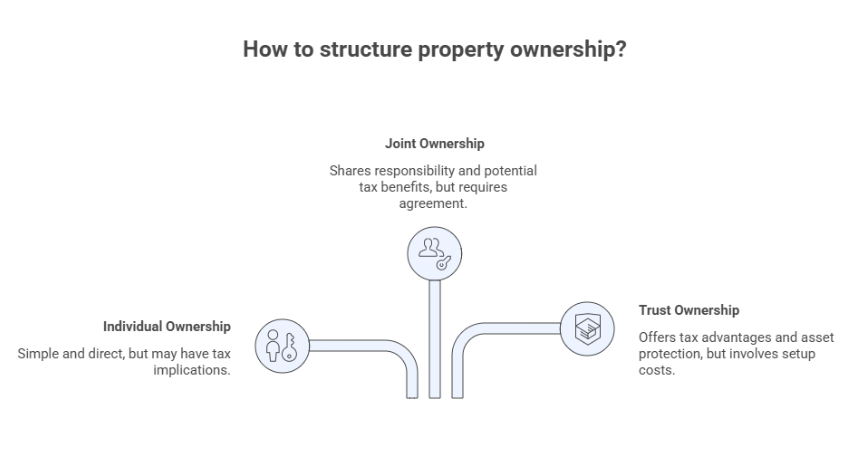
Session two is borrowing capacity and structural finance. How much can you actually borrow now? What if rates rise another 25 bps? Should the first property go in your name, your spouse’s, or jointly? Is a trust worth the setup cost? This is where DIY investors come unstuck the right structure often matters more than the right suburb. A 5% capital-growth differential is meaningful. A poorly structured ownership decision can eat that twice over in tax leakage.
Session three is the property thesis the what and the why detached or unit, owner-occupier or investor territory, established or new, growth-heavy or yield-heavy.
By session four you have a written plan: what you’re buying first, what is second, what trigger events move you forward, your refinancing schedule, your exit conditions. The philosophical case for why this orientation outperforms for most Australians sits inside Property Planning is Financial Freedom
Investors with a written plan make 80% of their decisions calmly. Investors without one make 80% on Saturday morning at an auction with adrenaline running.
Erskineville (2043) is the cleanest example of a scarcity-driven blue-chip. Five kilometers south-west of the CBD, heritage conservation overlay covering most stock, T4 line plus the Metro City & Southwest extension. House medians hover around $1.95M after a 38% increase over five years a CAGR of 6.6%. In February 2026, the suburb had 15 houses listed against 1,100+ active buyers. That isn’t a market it’s a queue. Full thesis in Why Erskineville is a 2026 Blue-Chip
Erskineville also offers a textbook two-speed micro-market. The unit segment — particularly low-rise 1960s and 70s blocks — has quietly outperformed the broader Sydney unit market, defying the “units underperform” narrative. The outperformance is quantified in Erskineville Units Outperforming the Sydney Average.
-> Must Read for the nuanced comparison with neighbours, Erskineville vs Newtown vs Alexandria
The point isn’t that you should buy in one of these. The point is that each requires a different investor profile, structure, and ten-year strategy. Only a property financial advisor at the strategy layer can resolve those distinctions.
Three scenarios where specialist advice isn’t optional the rules are dense enough that DIY mistakes are catastrophic rather than just expensive.
As of late 2024, around 6% of all SMSF assets sit in residential property and 11.2% in non-residential — a sector now over $1 trillion. The structure is governed by the SIS Act, enforced by the ATO, built around Limited Recourse Borrowing Arrangements (LRBAs) with the property held in a bare trust until the loan repays. SMSF loan rates in 2026 sit at 6.5–7.5%. Lenders typically want $200K–$250K fund balance and 30–40% deposit. The sole purpose test means no member or related party can ever live in or benefit from a residential SMSF property. The in-house asset rule caps related-party holdings at 5%. Breach it and the ATO can apply tax up to 47% on the fund’s total assets, not just the offending investment.
The tax upside is real — 15% on rental during accumulation, 10% effective CGT after 12 months, 0% in pension phase — but costs and complexity have to clear a real hurdle before it makes sense. F
Cash-flow-positive property. Conventional wisdom for fifteen years: growth or yield, not both. That wisdom is increasingly wrong in 2026. High Sydney rents, elevated yields in specific submarkets, dual-occupancy plays, and certain regional NSW pockets with metro-style demand have put genuinely cash-flow-positive deals back on the table — without sacrificing growth. Framework in Cash-Flow Positive Property is No Myth
Here’s what I’ve learned — from my own journey out of an IT career and into full-time Sydney investing, and from sitting across the table from hundreds of clients who started exactly where you are right now.
The next decade in Sydney property isn’t going to reward the people who guess right on rates, or who pick the “hot suburb” off a list, or who jump in because their cousin’s mate did well in 2018. It’s going to reward the people who sit down, build a real plan, and have someone in their corner who actually understands property — not just shares and super.
Look, I get it. Most professionals I meet are time-poor, well-paid, and quietly anxious about whether their hard-earned income is actually building anything. They’ve got one investment property bought in a hurry, an offset that isn’t structured properly, and no clear idea what the next move should be. That isn’t a strategy. That’s a story I’ve heard a hundred times — and it doesn’t have to be yours.
Sydney is a serious market. It demands serious thinking. But you don’t need to figure it all out alone — you just need the right person walking beside you. That’s what Property Hub Sydney is built for, and it’s what I show up to do every single day.
If something in this piece resonated, run your numbers through our Property Investment Calculator and let’s have a conversation. No pressure, no obligation — just a clear-eyed look at where you are, and where you could be. Sydney rewards investors who think in decades and act with precision. I’d be honoured to help you do exactly that.